Skip to content
W Kunsthaus Wanderwege

Cobblestones & Clock Towers

Switzerland's Historic Old Towns

From Bern's six kilometres of covered arcades to Stein am Rhein's hand-painted guild-house façades, Swiss old towns reward slow walkers. This guide covers walking routes, free sights, realistic CHF costs, and what to do when the rain sets in.

Cobbled street in a Swiss old town with historic guild buildings and a medieval clock tower

Five Towns, One Country — Where to Start

Switzerland is not a large country, but its old towns sit at very different altitudes, speak different languages, and carry completely different atmospheres. Bern is the political capital and a UNESCO World Heritage Site — its arcades (Lauben) are the longest covered pedestrian walkways in Europe at roughly six kilometres, and they matter enormously on a grey October afternoon. Lucerne is compact, photogenic, and heavily visited, but it rewards those who arrive early and explore the quiet lanes behind Weinmarkt. Stein am Rhein, on the eastern Rhine, is arguably the most visually striking medieval streetscape in the German-speaking world. Basel straddles the Rhine physically and culturally, a city shaped equally by its art fairs, pharmaceutical industry, and a fiercely independent medieval spirit. Lugano, in the Italian-speaking canton of Ticino, feels like a different country entirely — piazzas, palm trees, espresso at outdoor tables, and a lake that mirrors the southern Alps.

Each town can be reached by public transport, covered under a Swiss Travel Pass, and explored on foot in a single day — though all five reward a night's stay. We have rated them not by prestige but by what they offer the independent walker who wants to understand a place rather than merely photograph it. If you are building a one-week Swiss itinerary, mountain railway day trips pair naturally with old-town evenings; the late light in Bern's Rosengarten after a day on the Berner Oberland Railway is one of the finer free pleasures in Switzerland.

Town by Town

Practical details, walking routes, and honest assessments for each destination.

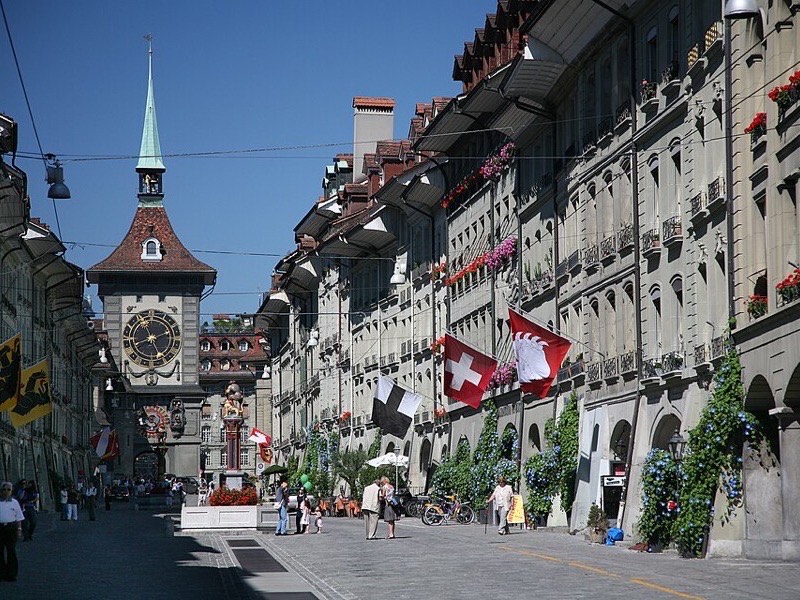
Bern's medieval arcade street with the Zytglogge clock tower in the background
UNESCO World Heritage

Bern

Switzerland's capital is deceptively easy to underestimate. Arrive at the Hauptbahnhof and descend immediately into the Lauben — the arcaded sandstone walkways that line Spitalgasse, Marktgasse, and Kramgasse. The Zytglogge, built in the 13th century, still runs its astronomical clock mechanism; guided tower tours (CHF 20, adults; May–October, 11:30 and 14:30) fill within the hour of opening. The Bern Historical Museum on Helvetiaplatz (CHF 13; Tuesday–Sunday 10:00–17:00) gives the UNESCO context without being dry. Walk east across the Nydeggbrücke, climb to the Rosengarten for a view across the Aare meander, then descend through the Matte quarter — the old river district — before returning along the lower arcade. Budget three hours for the core route; five for a thorough day. The whole old town is free to walk.

Request a Bern route plan →
Lucerne's Chapel Bridge spanning the Reuss river with the Water Tower and flower boxes
Most Photographed Bridge in Switzerland

Lucerne

The Kapellbrücke (Chapel Bridge) is the single most recognised image in Swiss tourism, and it is free to walk across at any hour. Built in 1333, largely destroyed by fire in 1993 and reconstructed, it still displays 17th-century triangular paintings under its roof. The Water Tower beside it is privately owned and not open to visitors, but it photographs best from the Reuss embankment at Rathausquai. From the bridge, walk north into the old town via Kornmarkt and Weinmarkt — the latter is a quiet square the tour groups miss. The Historisches Museum Luzern (CHF 12; Tuesday–Sunday 10:00–17:00) sits in the old Arsenal on Pfistergasse. For the overview, climb Museggmauer — the preserved medieval ramparts with nine towers — between April and October for free. Last entry 18:00. Rainy-day option: the Kultur und Kongresszentrum on the lakefront has a free public foyer with rotating exhibitions.

Request a Lucerne route plan →
Stein am Rhein's Rathausplatz lined with Renaissance-painted façades and flower-box windows
Best-Preserved Painted Streetscape in Switzerland

Stein am Rhein

Stein am Rhein is a small town — population under 3,500 — and its Rathausplatz is not large. But no square in Switzerland concentrates more ornamental Renaissance painting per square metre. Each guild house on the market square bears a full-façade fresco: Der Weisse Adler (The White Eagle), Zum Roten Ochsen (The Red Ox), Sonne (The Sun) — painted or repainted between the 15th and 18th centuries and maintained by cantonal preservation orders. Entrance to the town and the square is free. The Kloster St. Georgen, a Benedictine monastery converted into a museum, charges CHF 5 (Tuesday–Sunday 10:00–17:00, April–October only). The Rhine walk from the railway station to the old town takes eight minutes; continue east along the river bank for a view back across the town from the German shore. From here you can connect onward to Schaffhausen and the Rhine Falls, Switzerland's most powerful waterfall, 30 minutes by train.

Request a Stein am Rhein itinerary →
Basel's Marktplatz with the red sandstone Rathaus façade and open-air market stalls
Museum Capital of Switzerland

Basel

Basel contains more museums per capita than any other Swiss city, which makes it the natural rainy-day destination. The Marktplatz — presided over by the deep-red sandstone Rathaus — is the civic heart, and the Saturday market is among the best-stocked in Switzerland (07:00–13:00, year-round). Walk from Marktplatz to the Münster, the Romanesque-Gothic cathedral, for free entry and a terrace overlooking the Rhine bend. The Kunstmuseum Basel, a ten-minute walk up Dufourstrasse, is one of the oldest public art collections in the world; full details are in our art museums guide. The medieval Spalentor gate, a remnant of the city walls, is eight minutes on foot from the museum. Cross the Rhine on one of the four Fähri wooden cable ferries (CHF 2 each crossing; powered only by river current) for one of the best views of Klein-Basel's riverside. Old-town walking: allow two hours minimum; four hours for museums.

Request a Basel route plan →
Lugano's Piazza della Riforma with outdoor café tables and the Palazzo Civico colonnades
Italian Switzerland

Lugano

Lugano operates at a different pace to German-Swiss towns — slower, louder, more interested in lunch. The Piazza della Riforma is a proper Italian piazza: open, café-fronted, animated. Via Nassa, the pedestrian shopping lane running south-west from the piazza, leads past medieval arcades to the Cattedrale San Lorenzo, whose Romanesque façade and Renaissance interior are free to visit (daily 07:30–18:00). The MASI Lugano art museum on the Piazza Bernardino Luini has a permanent collection of Ticino Modernism (CHF 15; Tuesday–Sunday 10:00–18:00). For the panorama, take the funicular from Piazza Cioccaro to Monte San Salvatore (CHF 25 return; operates April–November) — on a clear day you can see down the lake toward Lake Como in Italy. Lugano connects to the broader Swiss lake network, and its old town is a natural complement to a day on Lake Lugano by boat.

Request a Lugano route plan →
Rain-wet cobblestones in a Swiss old town arcade with warm café light visible through windows
Rainy-Day Survival Guide

When the Weather Turns

Swiss weather changes quickly and old-town visits need a wet-weather plan. Bern is uniquely self-solving: the six-kilometre arcade covers the entire core route, and you can walk from the station to the Nydegg without getting wet. In Lucerne, the Historisches Museum and the KKL foyer provide shelter; the chapel bridge itself has a roof. Basel's Kunstmuseum and Museum der Kulturen are within a covered-arcade walking radius. In Stein am Rhein, the monastery museum is the obvious refuge; the town's single main street can be walked in its entirety under shop awnings. In Lugano, the covered arcades of Via Nassa and the MASI museum handle most rain scenarios. For structured rainy-day planning across all regions, our national parks guide covers visitor centres and indoor interpretive facilities in remote areas as well.

Request a weather-resilient itinerary →

Walking Routes at a Glance

Distances, durations, and key stops for the core pedestrian route through each old town.

Town Route Distance Walking Time Key Stops Free Highlights Paid Entry (from)
Bern 4.5 km loop 2.5–3 hrs Käfigturm → Zytglogge → Münster → Nydeggbrücke → Rosengarten → Matte Arcades, Bern Cathedral terrace, Rosengarten viewpoint CHF 13 (Historisches Museum)
Lucerne 3 km loop 2–2.5 hrs Kapellbrücke → Weinmarkt → Museggmauer → Löwenplatz → Spreuerbrücke Chapel Bridge, Museggmauer ramparts, Spreuerbrücke CHF 12 (Historisches Museum Luzern)
Stein am Rhein 2 km loop 1.5 hrs Station → Understadt → Rathausplatz → Kloster St. Georgen → Rhine walk Rathausplatz painted façades, Rhine embankment CHF 5 (Kloster St. Georgen)
Basel 5 km loop 3–4 hrs Marktplatz → Münster → Rhine ferry → Klein-Basel → Spalentor → Kunstmuseum Münster, Rhine ferry views, Spalentor gate CHF 2 (Rhine ferry) · CHF 26 (Kunstmuseum)
Lugano 2.5 km loop 2 hrs Funicular → Piazza Cioccaro → Piazza della Riforma → Via Nassa → Cattedrale San Lorenzo Piazza della Riforma, Cattedrale San Lorenzo CHF 15 (MASI Lugano) · CHF 25 (Monte San Salvatore funicular)

Getting There by Train

Transport Logic for an Old-Town Circuit

All five towns sit on the main SBB intercity and regional rail network. A Swiss Travel Pass — see our travel passes page for current rates — covers every connection listed here and discounts or waives most museum entry fees. Without a pass, point-to-point second-class fares apply; sample costs are listed below.

  • Zürich HB → Bern: 57 minutes by InterCity, trains every 30 minutes; CHF 52 one way.
  • Zürich HB → Lucerne: 46 minutes by InterCity, trains every 30 minutes; CHF 28 one way.
  • Lucerne → Stein am Rhein: Change at Schaffhausen; total approx. 1 hr 30 min; CHF 36 + CHF 5.20 one way.
  • Zürich HB → Basel SBB: 52 minutes by InterCity, trains every 30 minutes; CHF 34 one way.
  • Zürich HB → Lugano: 2 hours by InterCity via Gotthard Base Tunnel; CHF 68 one way.

An efficient multi-day old-town itinerary runs: Zürich arrival → Bern (night) → Lucerne (night) → Stein am Rhein (day trip from Lucerne or Zürich) → Basel (night) → Zürich departure, with Lugano as a separate southern extension. This meshes naturally with the mountain railway routes based out of Lucerne and Bern.

Day-Trip vs Overnight

Bern, Basel, and Lugano all have enough depth to justify overnight stays — Bern's evening arcade atmosphere is completely different from its daytime bustle, and Basel's restaurant scene is among Switzerland's finest. Lucerne and Stein am Rhein are credible day trips from Zürich or Bern. If you are travelling with children, our family attractions guide covers Lucerne's hands-on transport museum and Bern's Bear Park, both of which adjoin old-town walking routes.

Swiss railway platform with a red SBB train alongside a medieval town wall

What Is Actually Free

The instinct when visiting Swiss towns is to budget generously, and the instinct is not wrong — Switzerland is expensive. But the old-town experience is, in each of these five places, substantially free. Walking the Bernese arcades costs nothing. Crossing the Chapel Bridge costs nothing. Standing on the Rathausplatz in Stein am Rhein and reading the guild-house inscriptions costs nothing. The Rhine cable ferry in Basel costs CHF 2, which is the best CHF 2 spent in any Swiss city. Lugano's old piazza, its lakefront promenade, and its cathedral are all free.

Where you pay is for depth: the museum that explains why the arcades were built and what happened in the city over eight centuries; the tower tour that puts you inside the clock mechanism; the monastery that preserves the painted wooden ceilings behind a locked door. These costs are modest — CHF 5 to CHF 26 for individual museums — and a Swiss Travel Pass eliminates or halves most of them. Our recommendation is to spend freely on transport, use the Swiss Travel Pass to cover the three or four museums that genuinely interest you, and let the streets themselves carry the rest of the experience.

Frequently Asked Questions

Plan Your Old-Town Walk

Tell Us Which Towns You Want to Cover

We build day-by-day itineraries that combine old-town walks with transport connections, museum selections, and weather contingencies — no booking fees, no affiliate links.

Request a route plan View travel passes

Extend Your Time in Switzerland

Old towns are the urban complement to Switzerland's natural landscapes. Here is how they connect.

Mountain Railways

Lucerne is the gateway to Pilatus and Rigi; Bern to the Jungfrau region. A morning on the rack railway and an afternoon in the old town is a well-tested combination that uses the same Swiss Travel Pass for both legs.

Seasonal Festivals

Basel Fasnacht in February, Lucerne's Fasnacht in the same period, and Bern's Onion Market in November are all rooted in the medieval old-town geography. The festivals are inseparable from the streets they occupy.

Family Attractions

Lucerne's Verkehrshaus (Swiss Museum of Transport), Bern's Bear Park on the Nydeggbrücke, and Basel's Natural History Museum all sit within easy walking distance of the old-town routes described above.